

Why AI Training Fails Without Leadership in the Room
A practical observation from legal coaching sessions across Australian and New Zealand firms
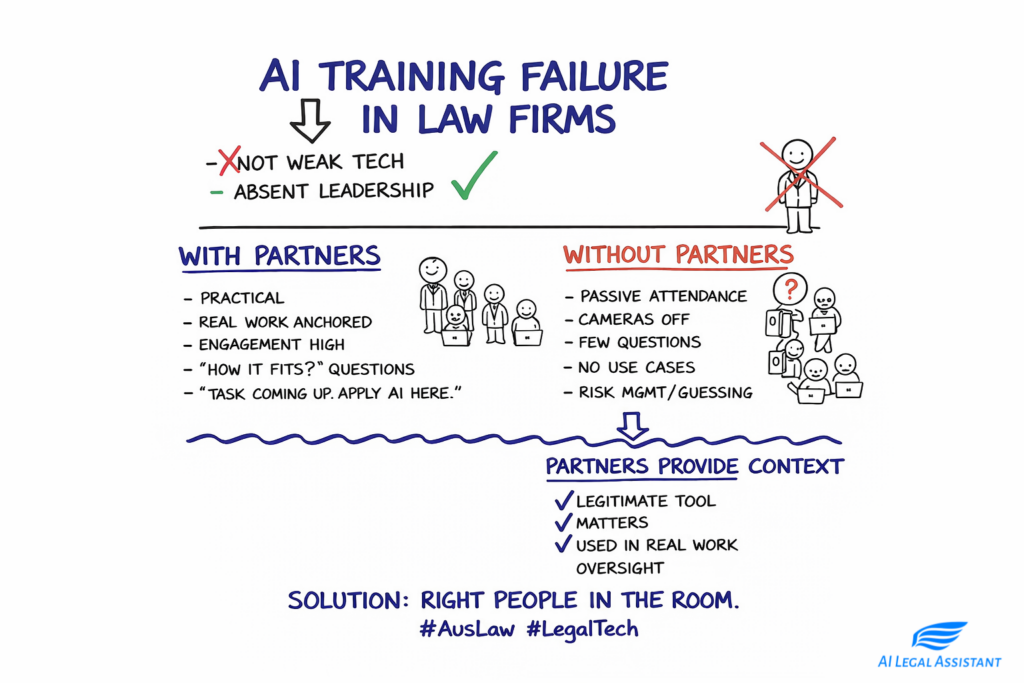
There is a pattern that emerges quickly when you spend enough time inside law firms running AI coaching sessions. It is consistent across jurisdictions, firm sizes, and practice areas. And once you see it, you cannot unsee it.
The success or failure of a session has very little to do with the sophistication of the technology being discussed. It has everything to do with who is in the room.
When partners attend, sessions are productive, practical, and grounded in real work. When they do not, engagement drops sharply. The same material. The same trainer. The same tools. Completely different outcome.
This is not a generational problem, a motivation problem, or a technology problem. It is a leadership problem.
What Engagement Looks Like When Partners Attend
When partners are present, the tone of the session shifts immediately.
Teams arrive interested. Not in an abstract sense, but in a practical one. They want to understand how the tool fits into their practice, their matters, and their workflows. They come with questions because they have already tried to imagine where the friction points will be.
More importantly, they treat the session as a working meeting, not a passive demonstration.
It is common to hear a partner say something like:
“We’ve got this task on our list this week. John, why don’t you think about how we could use this there? ”
That single sentence changes everything.
Suddenly, the discussion is anchored in real work. The technology stops being theoretical. Junior staff are not being asked to “learn AI” in the abstract; they are being asked to apply it to an actual task with an actual deadline.
When this happens, sessions become collaborative rather than instructional. Questions emerge organically. The conversation moves beyond what the tool does to how the firm will actually use it. The session has momentum because it is tied to authority and accountability.
In short, when partners attend, the session matters.
What Happens When Partners Are Absent
When partners are not present, the dynamic is markedly different.
Junior lawyers and paralegals often attend because they have been told to attend, not because they understand why they are there. Many arrive without preparation. Screens are blank. Cameras are off. Questions are rare.
When prompted, the response is often:
“No, not really. I don’t have anything to go through.”
This is not laziness. It is uncertainty.
Without partners in the room, junior staff are being asked to engage with a tool without any clear signal about whether its use is encouraged, expected, or even permitted in real work. They are understandably reluctant to take ownership of something that may later be questioned or second-guessed.
So they sit. They watch. Some multitask. The session becomes observational rather than participatory.
From their perspective, this makes sense. Junior lawyers are trained to manage risk by deferring to authority. In the absence of visible leadership endorsement, disengagement is a rational response.
The Mistake Firms Make When Rolling Out AI
Many firms assume that AI adoption is a bottom-up exercise. Train the juniors. Let them experiment. Innovation will filter upward.
That is not how law firms work.
Law firms are hierarchical institutions for good reason. Responsibility flows upward. Authority flows downward. New ways of working are legitimised by those who ultimately carry the most professional responsibility
When partners do not visibly engage, junior staff correctly infer that AI is peripheral rather than core. Something interesting, perhaps, but not something that will be rewarded or prioritised.
The result is predictable: low engagement, shallow understanding, and tools that are technically available but practically unused.
Why This Is Not About Motivation or Generations
It is tempting to frame this as a generational issue. Partners are motivated; juniors are disengaged. That framing is both inaccurate and unhelpful.
Junior lawyers are highly responsive to signals about what matters in a firm. They engage deeply with tasks that are clearly valued, supervised, and integrated into real work. They disengage from initiatives that feel experimental, optional, or politically ambiguous.
The difference in engagement is not about age or attitude. It is about context.
Partners supply that context simply by being present.
Leadership as a Practical Signal
When a partner attends an AI coaching session, they send several signals at once:
- This tool is legitimate
- This matters to the firm
- This will be used in real work
- Oversight and support exist
Those signals do more to drive adoption than any amount of training material, platform features, or internal messaging.
When those signals are absent, junior staff are left to guess. And in professional environments, guessing is something people are trained not to do.
The Practical Lesson
If a firm wants AI tools to be adopted meaningfully, partner involvement is not optional. Partners need to demonstrate presence, curiosity, and visible endorsement.
The most effective sessions are not those where the technology is the most impressive. They are the ones where leadership turns learning into action by anchoring it to real tasks, real matters, and real expectations.
AI does not fail in firms because staff are disinterested. It fails because leadership is absent at the moment it matters most.
The solution is not more training.
It is the right people showing up.

Post a comment
You must be logged in to post a comment.
Related Posts
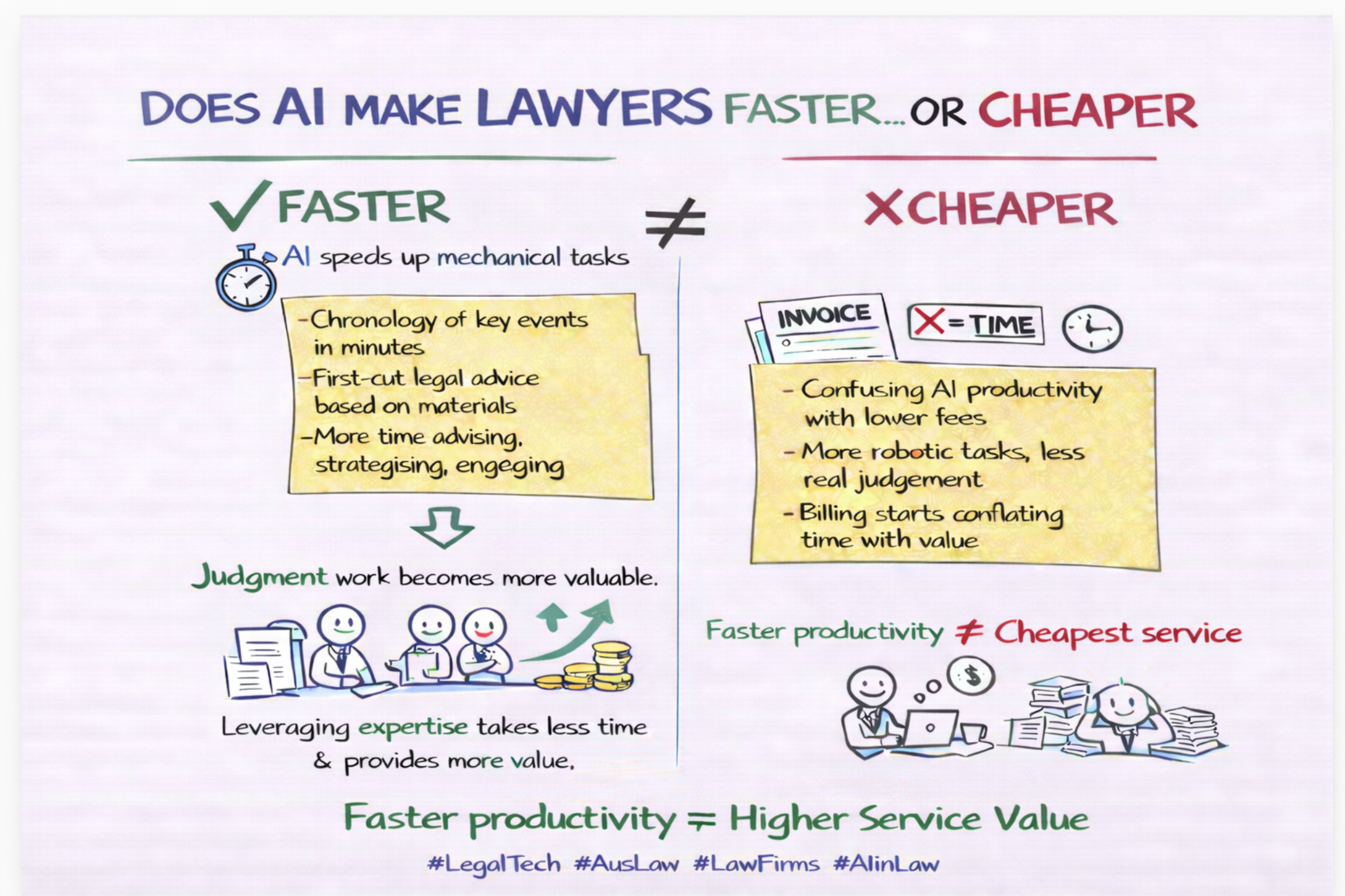
If AI Makes Lawyers Faster, Does It Make Them Cheaper? The Answer Isn’t What You Think.
If AI Makes Lawyers Faster, Does It Make Them Cheaper? The Answer Isn’t What You…