

The Future of Legal Careers in an AI-Enabled Australian Firm
Few questions provoke as much internal debate within law firms as this:
If AI performs drafting, summarisation and initial research tasks, what happens to junior lawyers?
The concern is understandable.
For decades, early-career development in Australian legal practice relied heavily on repetition. Junior solicitors refined their skills through:
- Research memoranda
- Discovery review
- Chronology compilation
- Precedent completion
- Document summation
These tasks built discipline, attention to detail and familiarity with structure.
But they also consumed significant time on mechanical processes that, while necessary, did not always cultivate higher-order legal reasoning.
AI introduces a structural shift.
Not in the need for junior lawyers — but in how they develop.
A Shift From Repetition to Interpretation
AI accelerates first drafts, document structuring and preliminary research synthesis.
This does not eliminate learning.
It changes its nature.
Instead of spending hours formatting a clause, junior lawyers may spend more time interrogating:
- How a clause allocates risk in a particular manner
- How factual nuance alters the advice provided
- What commercial consequences flow from drafting decisions
- How regulatory obligations intersect with strategy
- Where litigation exposure may arise
The focus moves from mechanical production to critical evaluation.
This shift may strengthen professional maturity earlier in a career.
When repetitive strain decreases, intellectual engagement can increase — provided firms structure supervision accordingly.
The Evolution of the Internship Model
The traditional internship model in Australian law firms is built on observation, correction and gradual responsibility.
AI does not eliminate that structure.
It intensifies the need for it.
Supervision becomes more deliberate.
Senior practitioners must train juniors not only in legal doctrine, but in:
- Reviewing AI-generated outputs critically
- Identifying subtle inaccuracies or oversimplifications
- Questioning automated suggestions
- Maintaining independent reasoning
- Applying contextual judgement
AI becomes part of the training environment.
It does not replace the need for mentorship. In many respects, it increases its importance.
Junior lawyers must understand not only how to draft — but how to assess drafting tools responsibly.
Early Exposure to Strategic Thinking
One of the understated benefits of AI integration is earlier exposure to strategic analysis.
When junior lawyers are relieved from repetitive formatting or document structuring, they may have greater opportunity to:
- Participate in client strategy discussions
- Observe negotiation framing
- Assist in risk mapping exercises
- Contribute to advisory memoranda at a conceptual level
This accelerates exposure to the commercial realities of legal practice.
The development curve may become less about endurance and more about insight.
Retention, Expectations and Generational Shifts
The next generation of lawyers has grown up in a digital environment.
They expect technology to enhance workflows, not be excluded from them.
Firms that resist AI entirely may face recruitment and retention challenges. Digital fluency is increasingly viewed not as a novelty, but as baseline competence.
At the same time, early-career burnout remains a persistent issue in Australian and New Zealand practice. Repetitive administrative tasks, long hours spent on low-leverage processes and rigid billable expectations contribute to attrition.
Thoughtful AI integration can reduce some of this strain.
This does not imply reduced standards.
It implies a more sustainable training environment.
Structural Implications for Performance Metrics
AI integration may gradually influence:
- Billable expectations for junior lawyers
- Performance evaluation criteria
- Promotion pathways
- Allocation of research-heavy tasks
- Team composition in litigation and transactional matters
If drafting becomes more efficient, time alone becomes a weaker proxy for contribution.
Firms may increasingly evaluate junior lawyers on:
- Analytical quality
- Judgement development
- Client communication ability
- Strategic thinking
- Risk awareness
- Continual innovation and improvement contribution
The metrics of progression may shift.
Cultural Impact Within Firms
AI integration also affects firm culture.
Firms that treat AI as a shortcut risk diminishing skill development. Firms that treat it as supplementary labour — supporting but not substituting reasoning — may strengthen intellectual standards.
The difference lies in intention.
If AI is positioned as an assistant to legal thinking, not a replacement for it, culture evolves constructively.
Professional standards remain intact.
The Long-Term Outlook
AI does not eliminate the need for junior lawyers.
Legal reasoning, client trust, advocacy and regulatory interpretation remain fundamentally human disciplines.
What AI changes is the pathway to proficiency.
The firms that succeed will be those that:
- Integrate AI thoughtfully
- Maintain structured supervision
- Emphasise independent judgement
- Align technology with training frameworks
- View AI as an enabler of higher-order thinking
In this environment, early-career lawyers may spend less time formatting and more time thinking.
That is not a diminishment of training.
It is an evolution.
Next Step
We invite readers to share their thoughts and experiences with AI in the comments section below. Whether you’re a sceptic, enthusiast, or simply curious about the role of AI in legal practice, your insights are valuable to the broader discussion.
For those eager to stay abreast of AI and legal technology trends, subscribing for updates can ensure you’re always informed about the latest developments.
And for legal professionals ready to take a practical step towards integrating AI into their practice, exploring tools like the AI Legal Assistant can provide a valuable starting point. By automating routine tasks, this tool allows lawyers to focus on the more strategic aspects of their work, enhancing both productivity and the quality of client services.
#FutureOfLaw #LegalCareers #AusLaw #LegalAI

-
Previous Post
Why AI Training Fails Without Leadership in the Room
Post a comment
You must be logged in to post a comment.
Related Posts
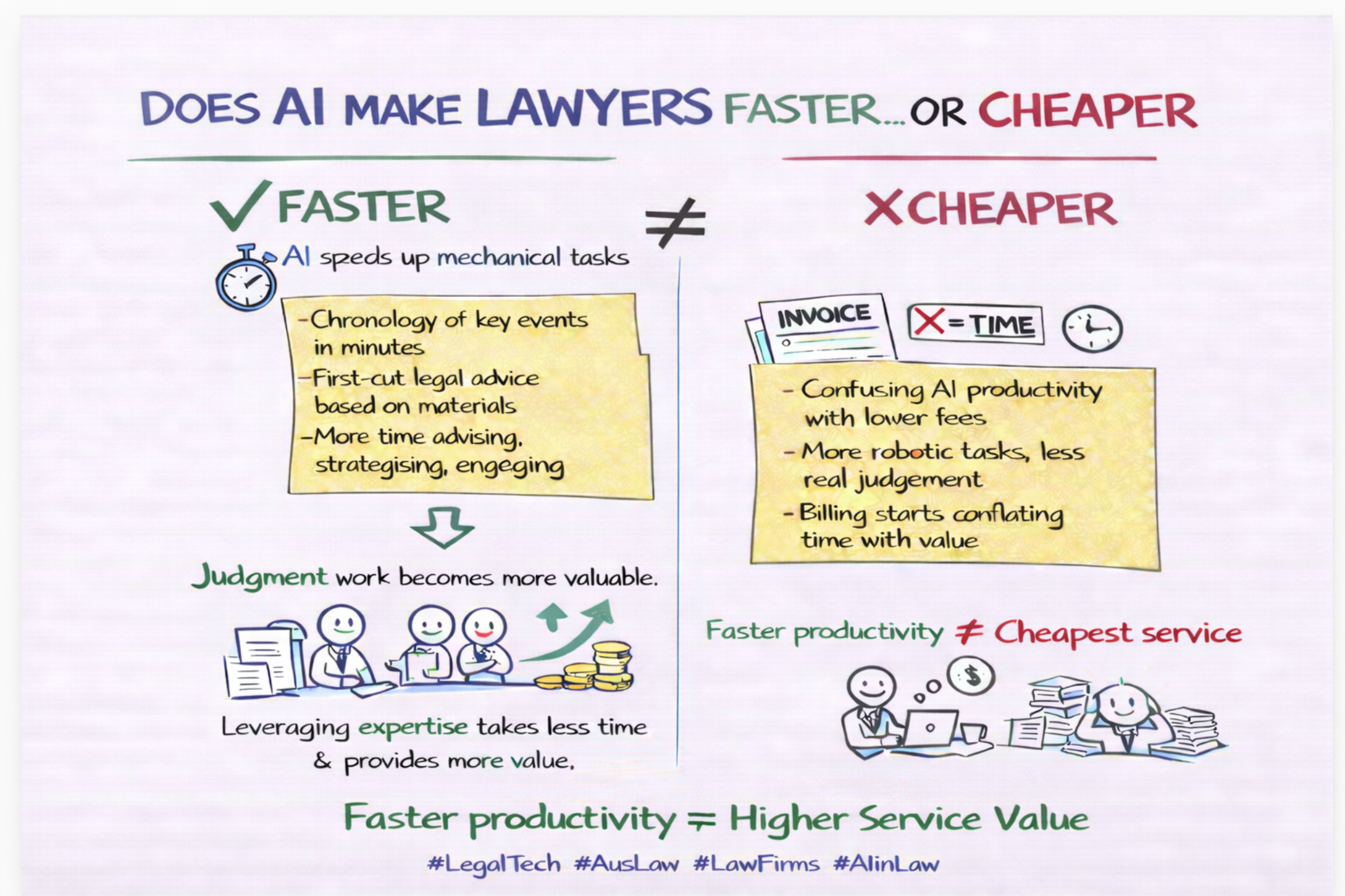
If AI Makes Lawyers Faster, Does It Make Them Cheaper? The Answer Isn’t What You Think.
If AI Makes Lawyers Faster, Does It Make Them Cheaper? The Answer Isn’t What You…