

If AI Makes Lawyers More Productive, Do They Have to Charge Less?
Artificial intelligence is no longer theoretical in Australian legal practice.
From drafting assistance to document review and research collation, AI is increasingly embedded within the day-to-day workflow of lawyers.
As adoption grows, a fundamental question is emerging:
If AI makes lawyers more productive, does that mean they should charge less?
At first glance, the answer appears straightforward. If a task that once required two hours can now be completed in thirty minutes, the assumption is that the cost should fall accordingly.
However, this view rests on a deeper premise that warrants closer examination: that time has always been an accurate proxy for value in legal services.
In practice, it rarely has been.
A Familiar Scenario, Viewed Through a Different Lens
Consider a typical matter within a law firm.
A senior associate is preparing advice late in the evening. They draw on prior files, internal precedents, and their own experience to draft a document. The process is methodical, but time-intensive. Several hours are spent assembling, refining, and structuring the advice.
The following day, a partner reviews the work.
Adjustments are made. A case has been cited too broadly. A provision requires clarification. The reasoning is largely sound, but refinement is necessary before the advice is delivered to the client.
This is an entirely ordinary process.
The time invested becomes part of the bill, and over time, this effort has been accepted as a reasonable proxy for value.
Now consider the same matter approached with AI assistance.
The associate begins with an AI-generated draft. Within minutes, they have a structured starting point, the issues outlined, relevant authorities identified, and a preliminary framework in place.
Platforms like Quillio AI Legal Assistant are designed to deliver exactly this kind of high-quality first draft while keeping the lawyer’s judgment at the centre of the process.
However, the core work remains unchanged.
The associate must still:
- Verify the authorities
- Assess the applicability of the law
- Tailor the advice to the client’s circumstances
The partner’s review follows the same pattern, refining, testing, and validating the advice before it is finalised.
The outcome is materially the same.
The standard applied is the same.
The professional responsibility remains unchanged.
The only difference is the time taken to reach that point.
Productivity and the Misconception of Reduced Value
This scenario highlights a critical distinction.
AI reduces the time required to produce a first draft or complete process-driven tasks.
It does not reduce the intellectual or professional responsibility attached to the final advice.
With tools such as Quillio AI Legal Assistant, lawyers can accelerate routine elements while maintaining full oversight and control over the quality of the final work.
Clients do not engage lawyers for:
- document formatting
- administrative sequencing
- or the mechanical assembly of information
They engage lawyers for:
- judgment
- risk assessment
- strategic insight
- and confidence in the advice provided
These elements remain entirely unaffected by AI-driven efficiency.
If anything, the expectation of accuracy and reliability becomes more pronounced as speed increases.
This leads to an important conclusion:
Productivity gains do not inherently diminish value.
They simply compress the process of delivering it.
The Billable Hour Under Pressure
Where the impact of AI is most acutely felt is not in legal capabilities but in pricing models.
For firms operating predominantly on hourly billing structures, increased efficiency can initially appear as a commercial challenge. If less time is required, fewer billable hours are recorded.
However, this assumes that time spent is directly proportional to value delivered.
Increasingly, clients challenge that assumption.
Corporate clients are technologically literate. They are aware of automation and expect firms to operate efficiently. They are less willing to accept pricing models that reflect process rather than outcome.
As a result, firms that rely heavily on time-based billing for process-driven work may experience pressure.
Conversely, firms that price around
- expertise
- responsiveness
- commercial impact
- and outcome certainty
may find that efficiency strengthens, rather than erodes, their position.
The Role of Verification and Professional Responsibility
A related concern often raised is whether increased speed introduces greater risk.
In reality, the underlying professional standard has not changed.
Whether a draft originates from:
- a junior lawyer
- a precedent bank
- prior experience
- or an AI-assisted tool
The obligation remains consistent:
Verify before you rely.
Quillio AI Legal Assistant is built with this principle in mind, supporting faster workflows without compromising the lawyer’s duty to verify and apply professional judgment.
Legal practice has always operated within a framework of supervision, peer review, and accountability. These structures exist because all forms of work, human or otherwise, are subject to error.
AI does not introduce a fundamentally new category of risk.
It presents familiar risks in a different form.
Returning to the earlier scenario, whether the first draft is created manually or generated with AI assistance, the same review processes apply. The same scrutiny is required. The same professional judgment is exercised.
The responsibility for the final work product remains with the lawyer.
Capacity, Not Commoditisation
Another concern frequently raised is whether increased productivity leads to commoditisation.
In practice, greater efficiency often produces a different outcome.
It creates capacity.
Capacity to:
- engage earlier in client matters
- improve turnaround times
- deepen advisory relationships
- and focus on higher-value strategic work
Australian solutions like Quillio AI Legal Assistant help create this additional capacity while respecting the realities of legal practice and professional responsibility.
For Australian firms managing increasing regulatory complexity, client expectations, and data-intensive matters, this additional capacity can materially improve both service delivery and internal sustainability.
Efficiency, therefore, does not necessarily lead to lower value.
It can enable differentiation.
Reframing the Question
The central question: Should lawyers charge less if they become more productive? may ultimately be the wrong one.
A more relevant question is
What are clients actually paying for?
If the answer is time, then increased efficiency creates tension.
If the answer is expertise, judgment, and outcome, then efficiency enhances the ability to deliver that value more effectively.
AI does not diminish legal work.
It reveals what aspects of that work were never truly valuable to begin with.
Conclusion
The integration of AI into Australian legal practice is not a question of if, but how.
As productivity increases, firms face a choice.
They can attempt to preserve traditional pricing structures tied closely to time, or they can reassess how value is defined and communicated.
The firms that will perform best are unlikely to be those that simply work faster.
They will be those who understand:
Efficiency does not reduce value.
It exposes it.

Post a comment
You must be logged in to post a comment.
Related Posts
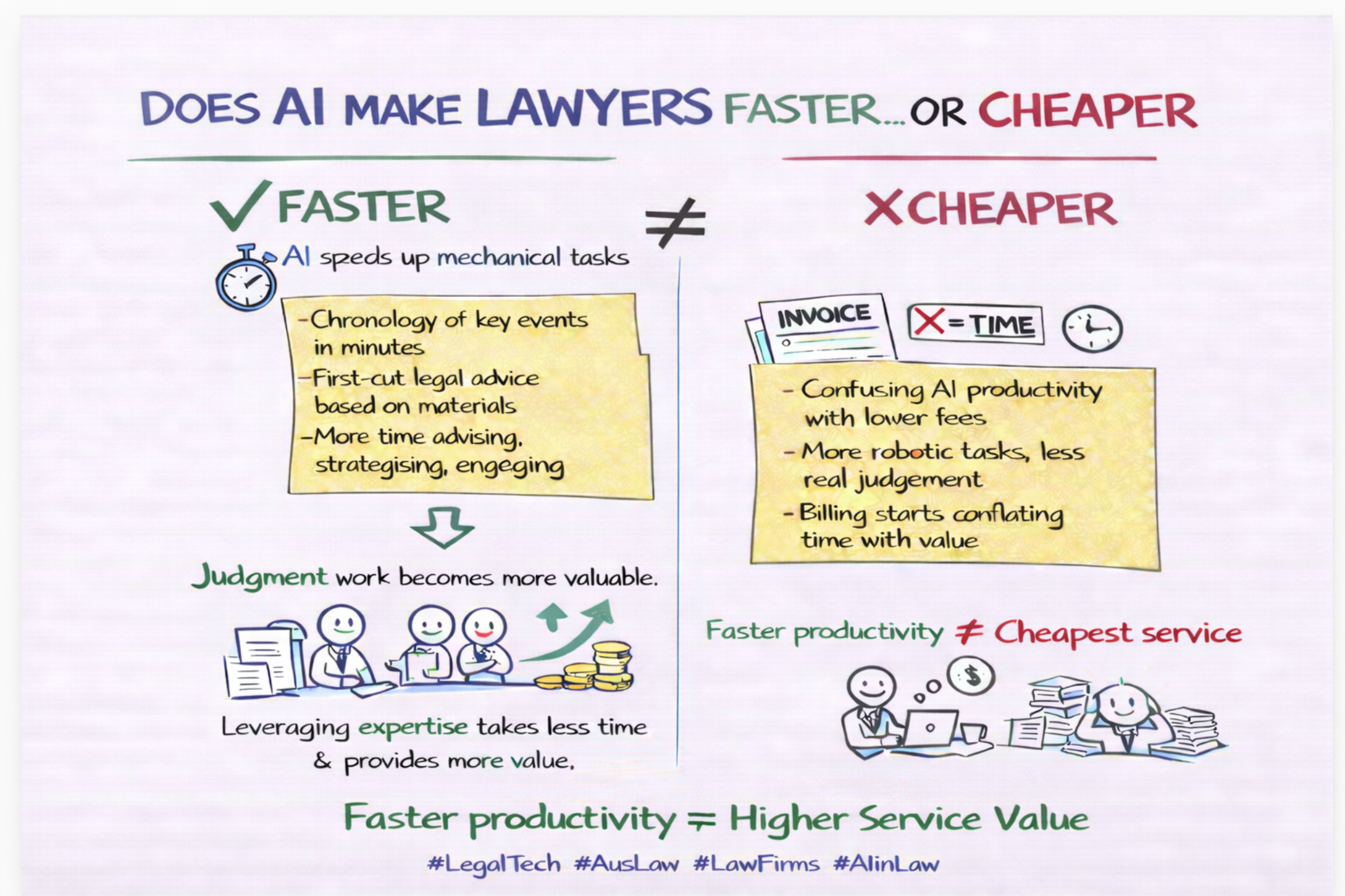
If AI Makes Lawyers Faster, Does It Make Them Cheaper? The Answer Isn’t What You Think.
If AI Makes Lawyers Faster, Does It Make Them Cheaper? The Answer Isn’t What You…
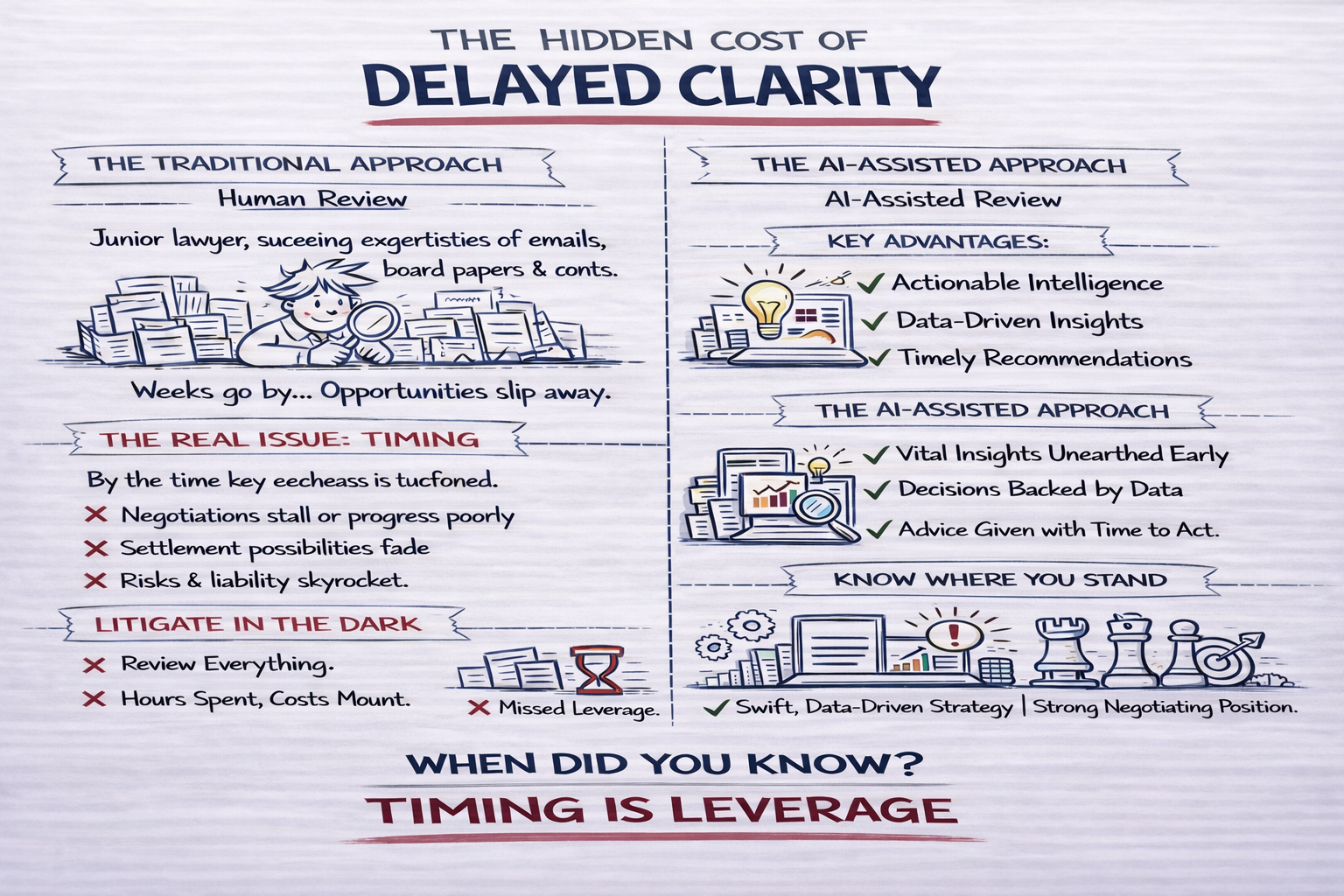
AI in Litigation and E-Discovery: Strategic Transformation Beyond Efficiency
AI in Litigation and E-Discovery: Strategic Transformation Beyond Efficiency Litigation has always been defined by…