

If AI Makes Lawyers Faster, Does It Make Them Cheaper? The Answer Isn’t What You Think.
Every legal technology conversation eventually arrives at the same uncomfortable question. If AI lets a lawyer draft a chronology in twenty minutes instead of three hours, what happens to the other two hours and forty minutes on the bill?
It’s a fair question. And it deserves a more honest answer than most legal tech companies or most law firm partners are willing to give.
Because the real answer isn’t that lawyers need to charge less, and it isn’t that they need to scramble for more clients to fill the gap.
The real answer is that AI is forcing a reckoning with what legal services are actually worth, and that reckoning benefits good lawyers far more than it threatens them.
What “Faster” Actually Looks Like in Practice
It’s easy to talk about efficiency in abstract terms. It’s harder and more useful to look at what actually changes inside a real matter.
Take a common task: reviewing a large volume of correspondence to build a chronology for a dispute.
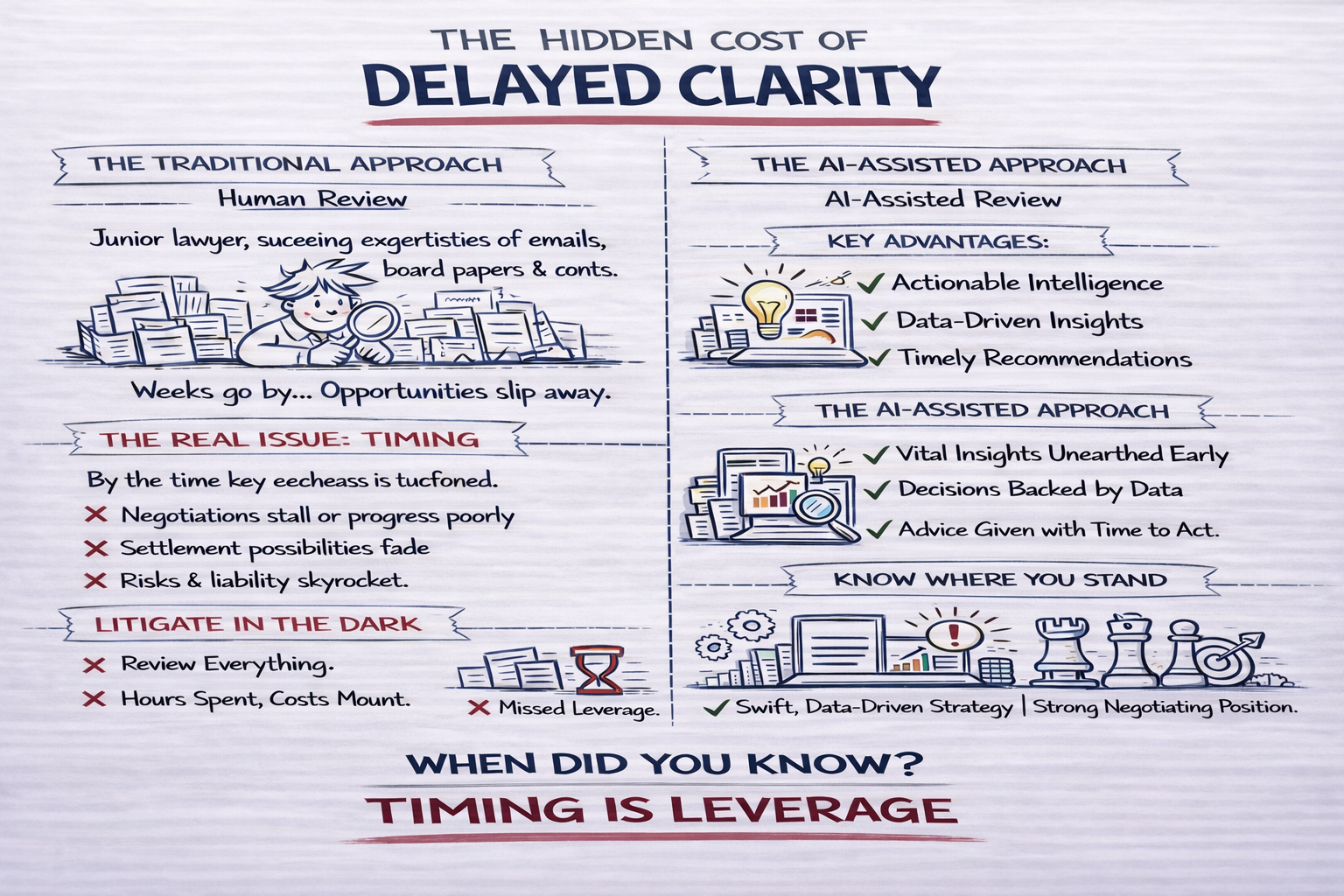
Traditionally, that work might involve hours of manual review. A lawyer reads through documents, extracts key events, orders them chronologically, and then refines the narrative. It is careful, necessary work, but also time-intensive and, in many respects, mechanical once the legal issues are understood.
With AI embedded into that workflow, the process looks different.
An initial chronology can be generated from the document set in minutes. Key dates are identified. Events are grouped. Gaps or inconsistencies are surfaced. The output is not final advice, but it is a structured, usable first draft.
Quillio AI Legal Assistant is built to deliver exactly this kind of fast, structured starting point while keeping full control and verification in the hands of the lawyer.
A typical first-pass output might look like this:
Sample Output: Chronology (Generated by AILA)
12 March 2022 — Initial supplier agreement executed between Client and Vendor
18 July 2022 — Client raises first performance concerns via email
02 September 2022 — Vendor acknowledges delays and proposes revised timeline
15 October 2022 — Internal escalation within the Client organisation regarding breach risk
03 January 2023 — Formal notice of breach issued by Client
Key Observations Identified:
Delay in acknowledgment by the Vendor may constitute an admission of non-performance
Gap in correspondence between October and December 2022 flagged for review
Potential inconsistency between the revised timeline and contractual obligations
What previously required many hours of effort is reduced to a short period of review, refinement, and validation.
The time is compressed. The responsibility is not.
The Productivity Trap That Isn’t Actually a Trap
There’s an assumption baked into this debate that if a task takes less time, it must be worth less money.
On the surface, that logic feels sound. But it collapses when you consider what the client is actually paying for.
A client reviewing a dispute chronology does not value the hours spent assembling it. They value whether the chronology is accurate, complete, and useful in shaping the case strategy. They value whether critical details were identified and correctly interpreted.
AI does not replace that judgment. It accelerates the path to it.
This is the approach Quillio AI Legal Assistant is designed for, helping lawyers move faster without compromising the quality or integrity of their professional judgment.
In practice, the lawyer’s role shifts. Less time is spent assembling information. More time is spent interrogating it, understanding what matters, what doesn’t, and what it means for the client’s position.
That shift does not reduce value. It makes the source of value more visible.
A Second Example: Drafting and First-Cut Advice
The same dynamic appears in drafting work.
Consider the preparation of an initial piece of advice. Traditionally, this involves gathering materials, reviewing precedents, structuring the response, and drafting from the ground up.
With AI, a first-pass draft can be generated quickly based on the relevant inputs. The structure is established. Key issues are addressed. The document is coherent and directionally correct.
For example:
Sample Output: Initial Advice Draft (Generated by AILA)
Issue:
Whether the Vendor’s delay constitutes a repudiatory breach of contract
Summary of Position:
Based on the correspondence reviewed, there is a reasonable basis to argue that the Vendor has failed to meet its contractual delivery obligations. The acknowledgment of delay dated 02 September 2022 may support an argument of anticipatory breach
Key Considerations:
Contractual clause requires delivery within agreed milestones
Vendor’s revised timeline appears inconsistent with original obligations
No formal variation agreement was identified in the reviewed documents
Preliminary Recommendation:
Client may consider issuing a formal notice of breach and reserving rights pending further clarification
But it is not the final product.
The lawyer’s role is to refine, to apply nuance, to ensure the advice reflects the specific commercial and legal context of the client. The quality of the final output still depends on expertise, not automation.
What changes is the starting point. Instead of a blank page, the lawyer begins with a working draft.
Again, time is reduced. Judgment remains central.
The Billable Hour Was Already Under Pressure, AI Just Made It Obvious
It’s worth acknowledging that this tension is not new.
The billable hour has been under pressure for years. Clients have questioned it. In-house teams have pushed back against it. Alternative fee arrangements have become more common across the market.
AI does not create that pressure. It simply exposes it more clearly.
When tasks that previously took hours can be completed in a fraction of the time, the link between time and value becomes harder to defend. Work that was once hidden within the process becomes visible as process.
For firms that rely heavily on hourly billing, that creates a structural challenge.
For firms that price around outcomes, expertise, and responsiveness, it creates an opportunity.
Because the cost of delivery decreases, while the value delivered, if anything, improves.
What Clients Actually Value
Firms often approach this issue from the wrong direction. They ask how to justify their fees when the work takes less time.
The better question is what clients actually value enough to pay for.
In practice, the answers are consistent.
Clients value speed because timing often affects commercial outcomes.
They value accuracy and completeness because mistakes are costly.
They value advice that reflects their business context, not just abstract legal principles.
They value responsiveness because legal issues rarely arrive at convenient times.
None of these is diminished by AI. They are enhanced by it.
A lawyer who spends less time on mechanical tasks has more capacity to deliver on these dimensions.
Faster turnaround. Better communication. More considered advice.
That is not a cheaper service. It is a better one.
AI Commoditises Tasks, Not Lawyers
The distinction that matters most is between process and judgment.
AI is highly effective at processing. It can organise information, generate drafts, and identify patterns across large datasets.
What it cannot do is exercise legal judgment in a way that reflects a specific client’s objectives, risk tolerance, and commercial environment.
That work remains inherently human.
If anything, AI sharpens that distinction. It reduces the time spent on work that was already trending toward commoditisation and increases the relative importance of the work that cannot be automated.
For experienced lawyers, that is a favourable shift.
The Practical Constraint: Adoption Inside Real Workflows
If the benefits of AI are so clear, the natural question is why adoption remains uneven.
In many cases, the issue is not resistance to change. It is friction.
Tools that require lawyers to step outside their existing workflow, to switch platforms, manually transfer information, or construct complex prompts, tend not to be used consistently.
Legal work is time-sensitive and interruption-heavy. Any tool that adds friction is quickly abandoned.
Quillio AI Legal Assistant was developed to minimise that friction by integrating smoothly into existing legal workflows rather than forcing lawyers to change how they work.
The firms seeing meaningful results are embedding AI where lawyers already work, within documents, within email, and within existing systems.
That integration allows AI to become part of the natural flow of work, rather than an additional task.
Risk, Governance, and Professional Responsibility
There is also a more immediate consideration.
Many lawyers are already using AI in some capacity. But relatively few have received structured training on how to use it appropriately.
That creates a gap between usage and governance.
Quillio AI Legal Assistant helps close this gap by combining strong AI capability with built-in governance features and clear human oversight, supporting responsible and confident adoption.
Unverified outputs, over-reliance on initial drafts, or misunderstanding the limitations of the technology can introduce real professional risk. This is not hypothetical. Courts have already encountered issues arising from the use of unverified AI-generated material.
The question for firms is no longer whether AI will be used.
It is whether it will be used in a way that is safe, controlled, and aligned with professional standards.
Rethinking What You Are Charging For
Ultimately, the impact of AI on pricing depends on what a firm is actually selling.
If the underlying model is time, then reduced time creates pressure.
If the model is based on expertise, judgment, and outcomes, then reduced time increases leverage.
This is where the real shift occurs.
AI does not require lawyers to charge less. It requires them to be clearer about what their fees represent.
The Question That Actually Matters
The question is not whether AI will reduce what lawyers can charge.
It is what legal practice looks like when less time is spent on process and more time is spent on judgment, strategy, and client relationships.
For many lawyers, that is not a loss.
It is a return to the core of the profession.
Final Thought
AI does not make good lawyers cheaper.
It makes the difference between process and expertise impossible to ignore.
And in doing so, it places greater value on the thing clients have always cared about most, sound judgment.”

Post a comment
You must be logged in to post a comment.
Related Posts
AI in Litigation and E-Discovery: Strategic Transformation Beyond Efficiency
AI in Litigation and E-Discovery: Strategic Transformation Beyond Efficiency Litigation has always been defined by…